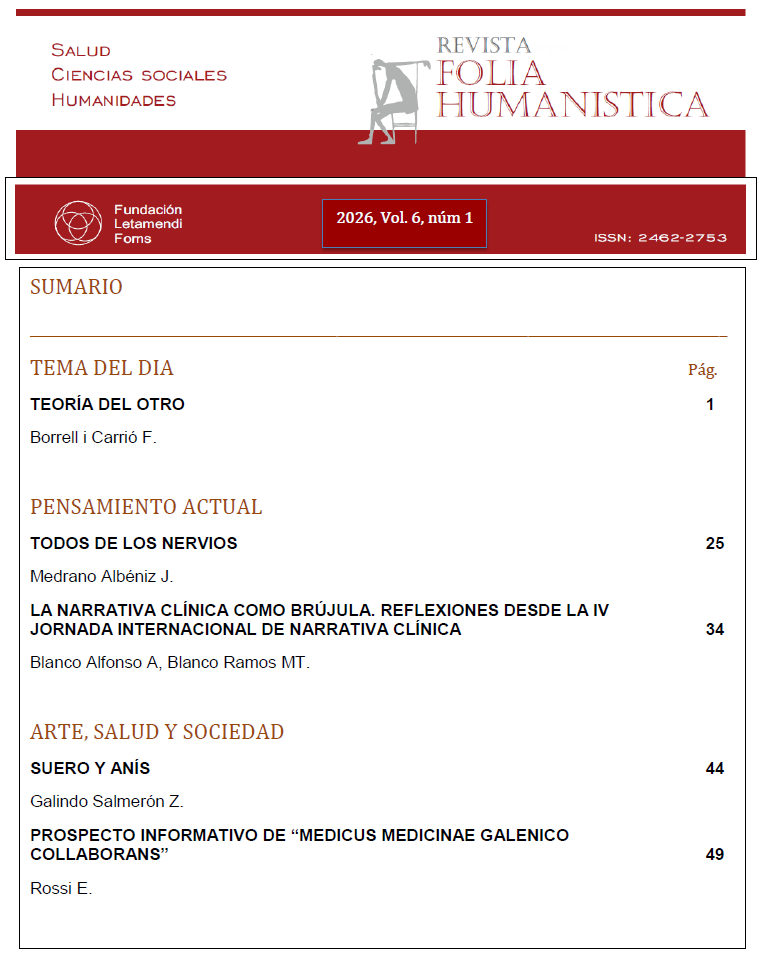
Clinical Narrative as a compass
Reflections from the 4th International Conference on Clinical Narrative
DOI:
https://doi.org/10.30860/0135Keywords:
Narrative Medicine, Empathy, Active listening (attention), BurnoutAbstract
Narrative Medicine (NM) is not merely a humanistic supplement, but an essential clinical and pedagogical tool. In a context of technological acceleration and the dehumanisation of care, NM emerges as a necessary bridge between "high tech" (the scientific domain) and "high touch" (relational and ethical skills).
The text highlights the urgency of reclaiming the spoken word against the coldness of objective data, pointing out that current training tends to focus on "hard sciences," causing a loss of empathy in students, a phenomenon known as the "third-year slump". NM proposes three fundamental pillars: attention, representation and affiliation. Attention trains deep listening and full presence with the patient; representation, through reflective writing, allows the professional to process and give meaning to experiences that are often lost in the rush of the consultation, both in terms of what the illness means for the patient’s life and environment, and in terms of introspection to analyse their own emotions and behaviour; and affiliation fosters communities of practice that reduce solitude and act as an antidote to burnout.
Furthermore, the article proposes the use of art, cinema and literature as "clinical simulators" that allow healthcare professionals to experience others' lives and develop more compassionate care before facing a real patient.
References
1. Goldman-Cecil L, Cooney KA. Tratado de Medicina Interna. 27ª ed. Elsevier; 2024.
2. Hojat M, et al. The devil is in the third year: a longitudinal study of erosion of empathy in medical school. Acad Med. 2009;84(9):1182-91.
3. Organización Médica Colegial (OMC). IKERBURN: De la vocación al agotamiento. Análisis del grado de burnout de los médicos jóvenes en España. 2025. Disponible en: https://www.cgcom.es/sites/main/files/files/2025-11/Ikerburn-Report.pdf
4. Esquerda M. Emociones a flor de piel: competencia emocional, la competencia olvidada en medicina [Internet]. Doctutor.es; 2025. Disponible en: https://www.doctutor.es/2025/05/26/emociones-a-flor-de-piel-competencia-emocional-la-competencia-olvidada-en-medicina/
5. Charon R, et al. The Principles and Practice of Narrative Medicine. Nueva York: Oxford University Press; 2017.
6. Beckman HB, Frankel RM. The effect of physician behavior on the collection of data. Ann Intern Med. 1984;101(5):692-6. doi: 10.7326/0003-4819-101-5-692.
7. Blanco Alfonso A, Blanco Ramos MT. La narrativa como herramienta profesional: Asignatura Transversal en la UAM para recuperar el Humanismo [Internet]. Universidad Autónoma de Madrid (UAM); 2025. Disponible en: https://www.uam.es/uam/investigacion/cultura-cientifica/articulos-cientificos/narrativa-humanismo
8. Domingo Moratalla T, Feito Grande L. Bioética narrativa. 2ª ed. Madrid: Guillermo Escolar; 2012.
9. Galichon I. (2024). Manifeste pour la médecine narrative. Pour une politique de la littérature dans le soin. Bordeaux: Éditions Le Bord de l’eau; 2024.
Downloads
Published
How to Cite
Issue
Section
License
Copyright (c) 2026 prueba

This work is licensed under a Creative Commons Attribution-NonCommercial-ShareAlike 4.0 International License.
La Revista Folia Humanística se adhiere a Creative Common en la modalidad: Reconocimiento – NoComercial – CompartirIgual (by-nc-sa): No se permite un uso comercial de la obra original ni de las posibles obras derivadas, la distribución de las cuales se debe hacer con una licencia igual a la que regula la obra original.