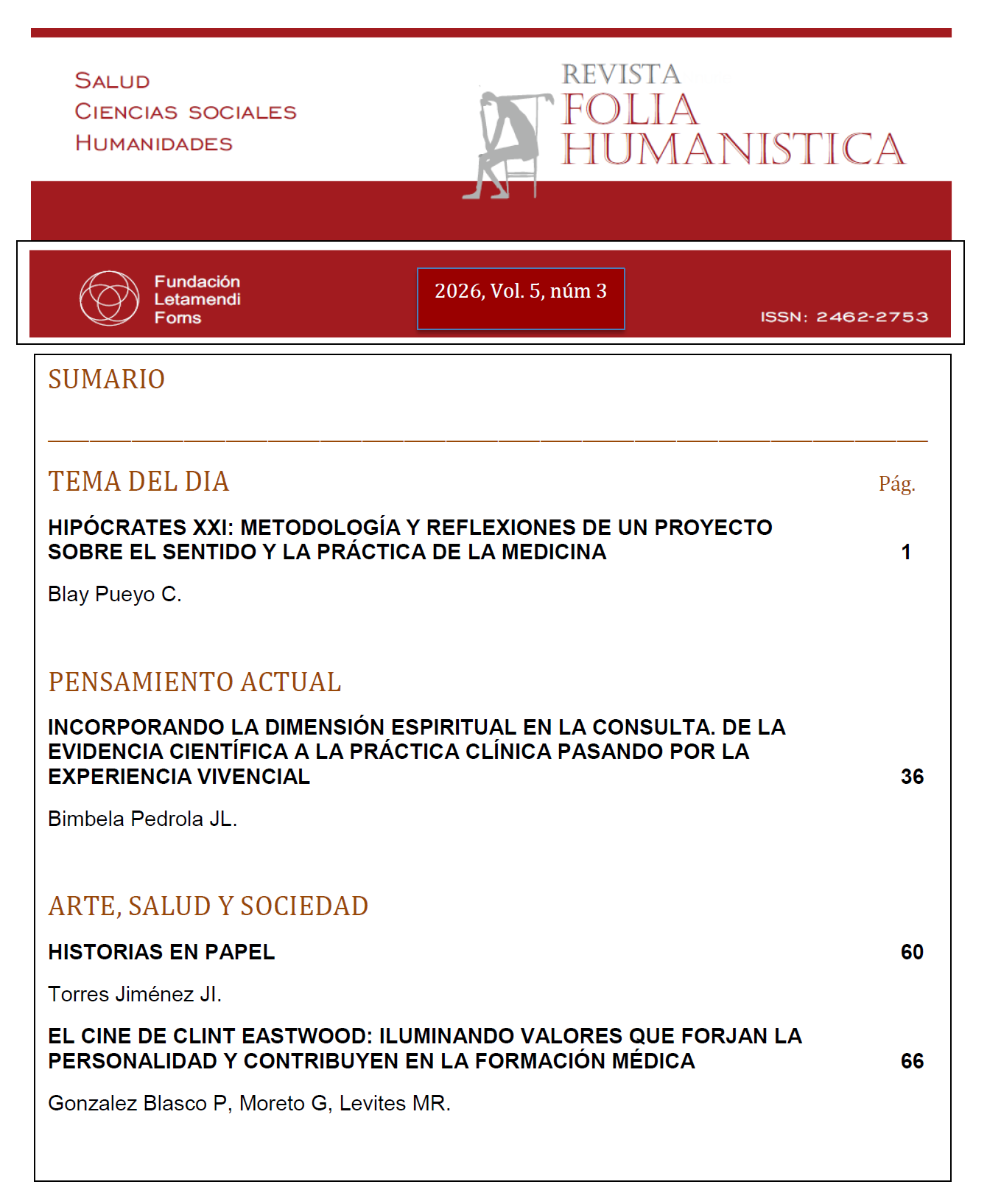
Hippocrates XXI
Methodology and reflections on a project about the meaning and practice of medicine
DOI:
https://doi.org/10.30860/0129Keywords:
Medical professionalism, Medical education, Transversal skills, Social contract, Humanistic medicineAbstract
The Hippocrates XXI project is an academic initiative designed to guide medical students and young doctors in the practice of their profession. The author bases this work on a compilation of experiences from 50 senior physicians and various focus groups, seeking to pass on a legacy that balances technical excellence with a human touch. Through a structure of 25 reflective chapters, critical topics such as error management, self-care, leadership and the impact of artificial intelligence are addressed. Drawing also on his experience as a university professor, the author emphasises the importance of renewing the social contract of medicine and fostering transversal skills in an increasingly complex healthcare environment. Ultimately, it serves as a practical and ethical guide to navigating the contemporary challenges of clinical practice through intergenerational dialogue.
References
1. Universitat de Vic-Universitat Central de Catalunya. Lideratge i professionalisme [Internet]. Vic: UVic-UCC; 2025 [consultado 27 Dic 2025]. Disponible en: https://www.uvic.cat/assignatura/6431
2. Gawande A. Being mortal: Medicine and What Matters in the End. New York: Metropolitan Books; 2014.
3. Kay A. This is going to hurt: Secret Diaries of a Junior Doctor. London: Picador; 2017.
4. Nuland SB. The Soul of Medicine: Tales from the Bedside. New York: Kaplan Publishing; 1994.
5. Gawande A. The Laws of Medicine: Field Notes from an Uncertain Science. Boston: Brandeis University Press; 2014.
6. Blay C. Hipòcrates XXI: Idees sobre el sentit i la pràctica de la medicina avui. Barcelona: Fundació Atenció Primària; 2025.
7. Duke A, Novicevic MM. Historical foundations of social effectiveness? Dale Carnegie’s principles. Soc Influence. 2008;3(2):132-142.
8. Elder A. Medicine is difficult—there are no shortcuts. BMJ. 2024;387:q2163.
9. Charon R. Narrative Medicine: A Model for Empathy, Reflection, Profession, and Trust. JAMA. 2001;286(15):1897-1902.
10. Baltes PB, Staudinger UM. Wisdom: A metaheuristic (pragmatic) to orchestrate mind and virtue toward excellence. American Psychologist. 2000;55(1):122-136.
11. Bruner J. Life as Narrative. Social Research. 1987;54(1):11-32.
12. Sandars J. The use of reflection in medical education: AMEE Guide No. 44. Med Teach. 2009;31(8):685-695.
13. Berwick DM. A user's manual for the IOM's 'Quality Chasm' report. Health Aff (Millwood). 2002;21(3):80-90.
14. Cruess RL, Cruess SR, Steinert Y, editors. Teaching Medical Professionalism: Supporting the Development of a Professional Identity. 2nd ed. Cambridge: Cambridge University Press; 2016.
15. Frenk J, Chen L, Bhutta ZA, Cohen J, Crisp N, Evans T et al. Health professionals for a new century: transforming education to strengthen health systems in an interdependent world. Lancet. 2010;376(9756):1923-1958.
16. Roca G. La revolució inevitable: Una càpsula sobre la societat de la Intel·ligència Artificial. Barcelona: Ara Llibres; 2025.
17. Murthy VL. The Generalist–Specialist Paradox of Medical AI. NEJM AI. 2025;2 (7).
18. ABIM Foundation, ACP-ASIM Foundation; European Federation of Internal Medicine. Medical professionalism in the new millennium: A physician charter. Ann Intern Med. 2002;136(3):243-246.
19. Heinrichs H, Kies A, Nagel SK, Kiessling F. Physicians’ Attitudes Toward Artificial Intelligence in Medicine: Mixed Methods Survey and Interview Study. J Med Internet Res 2025;27:e74187.
20. Jovell AJ, Navarro MD. Profesión médica en la encrucijada: hacia un nuevo modelo de gobierno. Madrid: Fundación Alternativas; 2006.
21. Samant M, Santosh S, Dutta S, Joshi M, Calnan M, Kane S. Understanding disruption in the social contract between the medical profession and society in India: a tale of mismatched expectations? Health Policy Plan. 2025;41(1):71-80.
22. Sharon T. When digital health meets digital capitalism, how many common goods are at stake? Big Data Soc. 2018;5(2):1-12.
23. Frank JR, Snell L, Sherbino J, editors. CanMEDS 2015 Physician Competency Framework. Ottawa: Royal College of Physicians and Surgeons of Canada; 2015.
24. Wald HS, Anthony D, Hutchinson TA, Liben S, Smilovitch M, Donato AA. Professional identity formation in medical education for humanistic, resilient physicians: pedagogic strategies for bridging theory to practice. Acad Med. 2015;90(6):753-760.
25. Chatzistamou I. Does Medical Education Require Radical Change? J Med Educ Curric Dev. 2024;11.
26. Pujol Farriols R. The MIR system at 50 years old, a value in need of pending changes. Med Clin (Barc). 2025;164(2):73-75.
27. Peri K, Eisenberg MJ. The Value of Board Recertification Among Physicians. Adv Med Educ Pract. 2024;15:595-598.
28. Phua GLG, Owyong JLJ, Leong ITY, Goh S, Somasundaram N, Poon EYL, et al. A systematic scoping review of group reflection in medical education. BMC Med Educ. 2024;24(1):398.
Downloads
Published
How to Cite
Issue
Section
License
Copyright (c) 2026 prueba

This work is licensed under a Creative Commons Attribution-NonCommercial-ShareAlike 4.0 International License.
La Revista Folia Humanística se adhiere a Creative Common en la modalidad: Reconocimiento – NoComercial – CompartirIgual (by-nc-sa): No se permite un uso comercial de la obra original ni de las posibles obras derivadas, la distribución de las cuales se debe hacer con una licencia igual a la que regula la obra original.