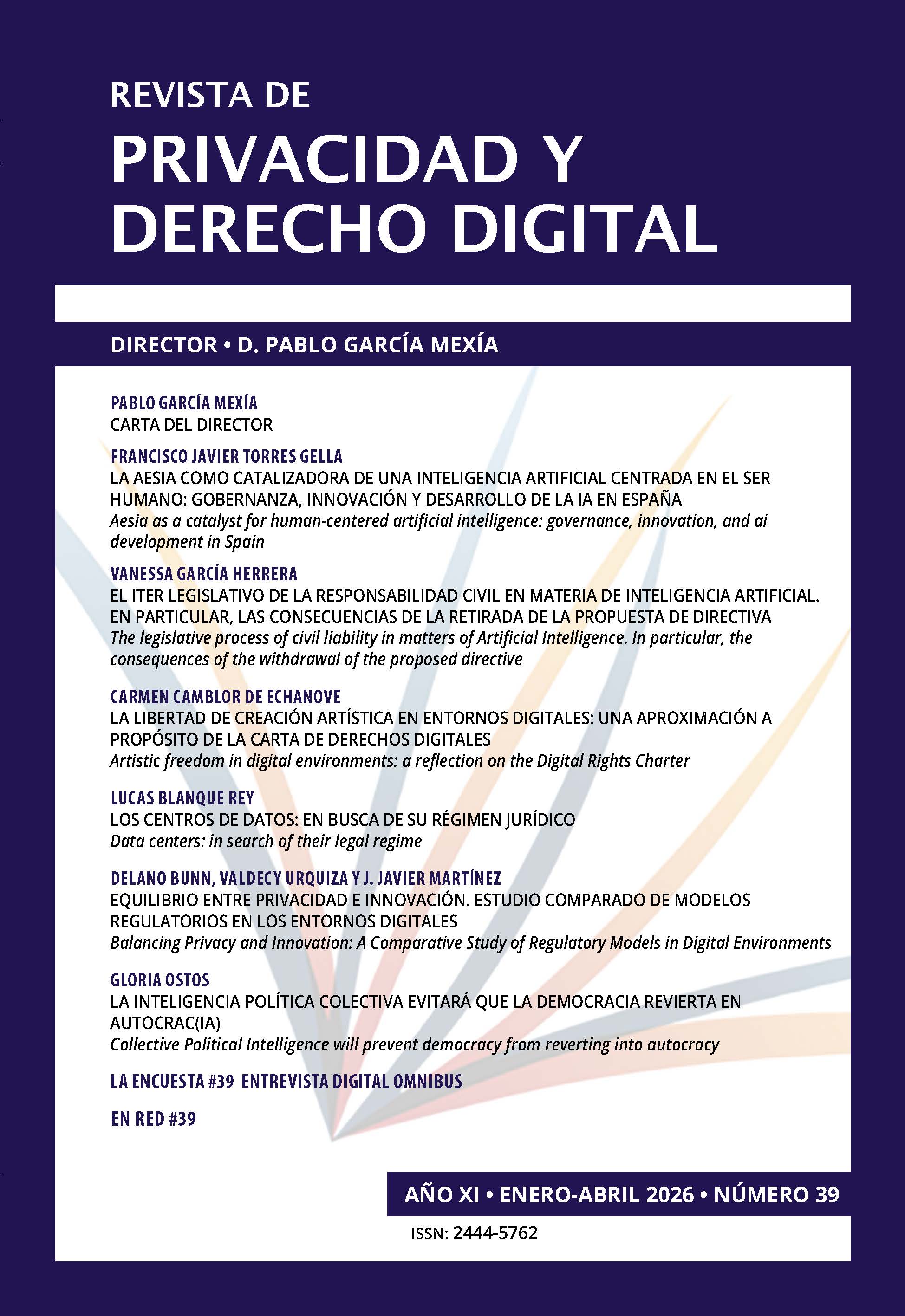
EQUILIBRIO ENTRE PRIVACIDAD E INNOVACIÓN.
ESTUDIO COMPARADO DE MODELOS REGULATORIOS EN LOS ENTORNOS DIGITALES
Palabras clave:
Privacidad de datos, innovación tecnológica, regulación digital, RGPD, LGPD, mercados digitales, economía de datosResumen
Este estudio analiza la tensión existente entre la protección de la privacidad y la promoción de la innovación en los mercados digitales a través de comparaciones de los marcos regulatorios en la Unión Europea y destaca en particular las situaciones en España y Brasil. La investigación señala los principales puntos de discordia entre ambos valores esenciales y examina cómo distintos enfoques regulatorios buscan armonizar estas demandas simultáneas. Mediante un exhaustivo examen de la literatura y un análisis documental cuidadosamente realizado por el estudio se demuestra que la protección de datos es crucial para garantizar los derechos fundamentales de las personas; sin embargo, se destaca que un marco normativo que ponga énfasis en la flexibilidad y proporcionalidad además de mantener una neutralidad tecnológica puede promover la innovación sin infringir indebidamente en la privacidad individual. Este trabajo contribuye al diálogo académico al presentar un modelo regulatorio equilibrado que reconoce el carácter contextual de la privacidad y resalta la relevancia de los datos como motor de la economía digital actual.
Descargas
Citas
Agrawal, A., Gans, J., & Goldfarb, A. (2018). Prediction Machines: The Simple Economics of Artificial Intelligence. Harvard Business Review Press.
Aridor, G., Che, Y.-K., & Salz, T. (2023). The effect of privacy regulation on the data industry: empirical evidence from GDPR. The RAND Journal of Economics, 54(4), 695–730
Bennett, C. J., & Raab, C. D. (2018). The Governance of Privacy: Policy Instruments in Global Perspective. Routledge.
Bioni, B. (2019). Proteção de Dados Pessoais: A função e os limites do consentimento. Forense.
Bradford, A. (2020). The Brussels Effect: How the European Union Rules the World. Oxford University Press.
Brynjolfsson, E., & McAfee, A. (2014). The Second Machine Age: Work, Progress, and Prosperity in a Time of Brilliant Technologies. W. W. Norton & Company.
Chen, C., Frey, C. B., & Presidente, G. (2022). Privacy regulation and firm performance: Estimating the GDPR effect globally (Working Paper n. 2022-1). Oxford Martin School, University of Oxford.
Cohen, J. E. (2019). Between Truth and Power: The Legal Constructions of Informational Capitalism. Oxford University Press.
European Data Protection Board. (2020). GDPR: Two Years After Implementation. EDPB Report 2020-01.
Gal, M. S., & Aviv, O. (2020). The Competitive Effects of the GDPR. Journal of Competition Law & Economics, 16(3), 349-391.
Goldfarb, A., & Tucker, C. (2011). Privacy Regulation and Online Advertising. Management Science, 57(1), 57-71.
Hartzog, W. (2018). Privacy's Blueprint: The Battle to Control the Design of New Technologies. Harvard University Press.
ISACA. (2024). Exploring Practical Considerations and Applications for Privacy-este hallaEnhancing Technologies. ISACA.
Janßen, R., Kesler, R., Kummer, M. E., & Waldfogel, J. (2022). GDPR and the lost generation of innovative apps (Working Paper No. 30028). National Bureau of Economic Research. http://www.nber.org/papers/w30028
Jia, J., Jin, G. Z., & Wagman, L. (2019). The Short-Run Effects of GDPR on Technology Venture Investment. NBER Working Paper No. 25248.
Martínez, D., Molero, A., Calle, E., Ametller, D. C., & Jové, A. (2025). Large-scale web tracking and cookie compliance: Evaluating one million websites under GDPR with AI categorization. Journal of Network and Computer Applications, 242, 104222. https://doi.org/10.1016/j.jnca.2025.104222
Mayer-Schönberger, V., & Cukier, K. (2013). Big Data: A Revolution That Will Transform How We Live, Work, and Think. Houghton Mifflin Harcourt.
Nissenbaum, H. (2020). Privacy in Context: Technology, Policy, and the Integrity of Social Life. Stanford University Press.
Parker, G. G., Van Alstyne, M. W., & Choudary, S. P. (2016). Platform Revolution: How Networked Markets Are Transforming the Economy and How to Make Them Work for You. W. W. Norton & Company.
Rubinstein, I. S. (2011). Privacy and Regulatory Innovation: Moving Beyond Voluntary Codes. I/S: A Journal of Law and Policy for the Information Society, 6(3), 355-423.
Solove, D. J. (2008). Understanding Privacy. Harvard University Press.
Thierer, A. (2016). Permissionless Innovation: The Continuing Case for Comprehensive Technological Freedom. Mercatus Centre at George Mason University.
Whitman, J. Q. (2004). The Two Western Cultures of Privacy: Dignity Versus Liberty. Yale Law Journal, 113(6), 1151-1221.
Zuboff, S. (2019). The Age of Surveillance Capitalism: The Fight for a Human Future at the New Frontier of Power. PublicAffairs.