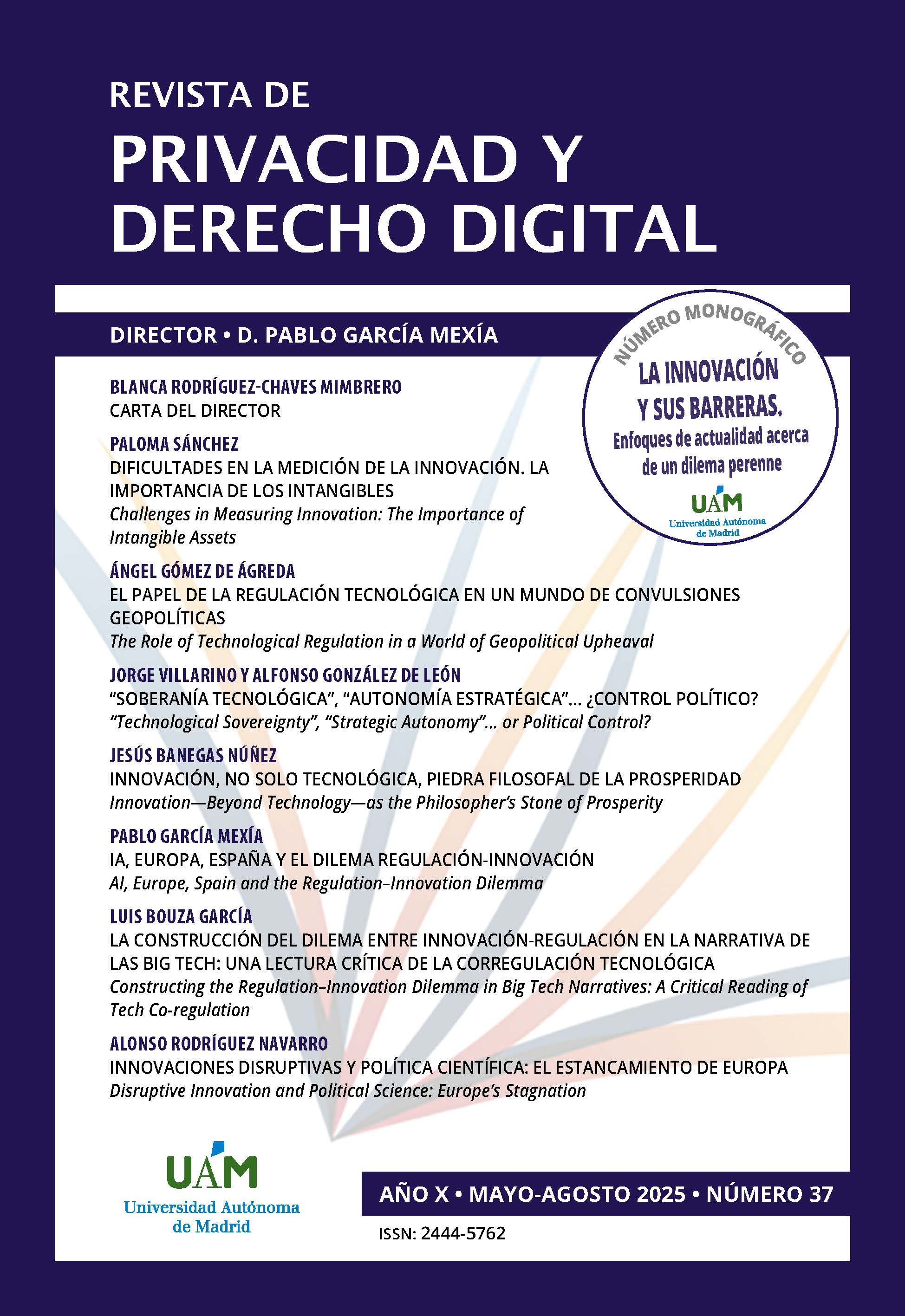
Innovation, not just technological, is the philosopher's stone of prosperity.
Keywords:
economic and social progress, quality of life, economic growth, technological innovation, technological change, creative destruction, social and political institutions, human creativity, cultural and institutional environnments, dialogue between technology and science, limited resourcesAbstract
Economic and social progress has to do with people's standard of living and quality of life. Since it can be described, measured, and compared in historical time and space, we can venture to interpret the keys that determine it.
Until not long ago, in the mid-1940s, the factors that made possible the economic growth that generated the progress of nations were unknown with academic rigor. The great Austrian economist Joseph Schumpeter, with his theory of "creative destruction," had already anticipated the importance of technological innovation in the sustainability of wealth growth. A little later, Robert Solow—Nobel Prize winner, 1987—discovered and quantified the determining role of technological change in economic progress, quantifying it at 85%.
Since then, technological innovation has become very fashionable, more recently incorporating the institutional framework—social and political—that enables it, according to Douglass North—Nobel Prize winner, 1993.
Starting from the great human gift of creativity, analyzing the cultural and institutional environments that enable its development, discussing the dialogue between technology and science, describing the workings of innovation and also its much-disguised yet abundant enemies, the article concludes that human progress ultimately comes about thanks to the unhindered freedom of human entrepreneurship.
When entrepreneurs are free from obstacles to invention and innovation, the miracle of geometric progress in human living conditions occurs, and even—contrary to the prophets of doom—the expansion of the supply of limited resources.
Downloads
References
AGHION P. & ANTONIN C. & BUNEL S.: El poder de la destrucción creativa. ¿Qué impulsa el crecimiento económico? (2020). Ediciones Deusto, 2021.
ANTE, SPENCER A.: Creative Capital: Georges Doriot and the Birth of Venture Capital.Harward Business Press, 2008.
BBVA, FUNDACIÓN: El comportamiento de la productividad en España 1995-2022, 2024
BAUMOL, WILLIAM J.: Contestable Markets: An Uprising in the Theory of Industry Structure, American Economic Rewiev,1982.
BAUMOL, WILLIAM J.: The Free Market Innovation Machine. Princeton University Press, 2002.
CARR, NICHOLAS G.:Does IT matter? Harvard Business School Press,2004
CHRISTENSEN, CLAYTON: The Innovator´s Dilema: When New Technologies Cause Great Firms to Fail Harvard Business School Press, 1997.
CSIKSZENTMIHALYI, MIHALY: Flow and the Psycology of Discovery.
Harper Perennial, 1996.
DIAMOND, JARED: Armas, gérmenes y acero.La sociedad humana y sus destinos.(1997). Editorial Debate, 1998.
DOMÍNGUEZ, ANTONIO: España, tres milenios de historia. Marcial Pons, 2000.
ENRICH, JOSEPH: Las personas más raras del mundo (2020), Capitán Swing Libros, 2022
FERGUSON, NIALL: Civilization. The West and tthe Rest. Allen Lane, 2011.
FUKUYAMA, FRANCIS: Trust: The Social Virtues and the Creation of Prosperity. The Free Press, 1995.
GALOR, ODED: The Journey of Humanity. De Oigins of Wealth and Inequality. DUTTON, Pinguín Random House, 2022.
GIMPEL, JEAN: La revolución industrial en la Edad Media.(1975). Versión castellana, Taurus ediciones, 1981.
GRIBBIN, JOHN: Historia de la ciencia 1543-2001 (2002). Ed. Crítica, 2003.
HAYEK, FRIEDRICH A.: Los fundamentos de la libertad. Chicago University Press (1959). Unión Editorial, 1998.
HEDRICK, DANIEL R. Technology, a Word History. Oxford University Press , 2009.
McCLOSKEY, DEIRDRE N.: The Bourgeois Virtues. Ethics for an Age of Comerce. Chicago University Press, 1999.
LANDES, DAVID S.: Revolución del tiempo. El reloj y la formación del mundo moderno.(1999). Crítica, 2007.
MADDISON, ANGUS. Monitoring the World Economy 1820-1992. OCDE, 1995.
MOKYR, JOEL: De Lever of Riches. Technological Creativity and Economic Progress. Oxford University Press, 1990.
MOKYR, JOEL: A Culture of Roth. The Origins of the Modern Economy. Princeton University Press, 2017.
MORA, FRANCISCO: ¿Cómo funciona el cerebro?. Alianza Editorial, 3ª edición, 2014.
NORBERG, JOHAN: Abierto. La historia del progreso humano (2020). Deusto, 2021
NORBERG, JOHAN: El manifiesto capitalista. Por qué el libre mercado global salvará el mundo (2021). Deusto, 2024.
NORDHAUS, WILLIAM: Schumpeterian Profits in the American Economy: Theory and Measurement”. Revista NBE, Working Paper Series No. 10433, (2004).
NORTH, DOUGLASS C.: Understanding the Process of Economic Change. Princeton University Press, 2005.
OLSON, MANCUR: Auge y decadencia de las naciones. Yale University Press (1982). Ariel Economia, 1986
PAEPKE, C, OWEN: The Evolution of Progress: The End of Economic Growth and the Beginning of Human Transformation. Random House, 1993..
PHELPS, EDMUND: Mass Flourishing. Princenton University Press, 2015.
PINKER, STEVEN: Enlightenment Now. The case for reason, science, humanism and progress. Penguin Books, 2018..
RIDLEY, MATT: How Innovation Works. 4THSTATE.CO.OK, 2021.
ROSLING, HANS; Factfulness. Diez razones por las que estamos equivocados sobre el mundo. Y porqué las cosas están mejor de lo que piensas. Factfulness AB.(2018). Deusto, 2018.
SNYDER, LAURA J.: El club de los desayunos. Cuatro notables amigos que transformaron la ciencia y cambiaron el mundo.(2011). Acantilado, 2021.
SOLOW, ROBERT M: Growth Theory. An Exposition. Second Edition. Oxford University Press, 2000.
TORTELLA, GABRIEL: Las Grandes Revoluciones. La Esfera de los Libros, 2025.
TURPY, MARIAN L. & POOLLY, GALE L.: Superabundancia. Por qué a medida que crece la población crecen también los recursos disponibles. Cato Institute (2022). Deusto, 2023.
WALDENSTRÖM, DANIEL: Richer & More Equal: A New History of Wealth in the West.Polity Press,2024.
WHITE LYNN: Tecnología medieval y cambio social. (1962). 1ª Reimpresión en España, Paidós Básica, 1990.
WILSON, EDWARD O.: Los orígenes de la creatividad humana (2018). Ed. Crítica, 2018.