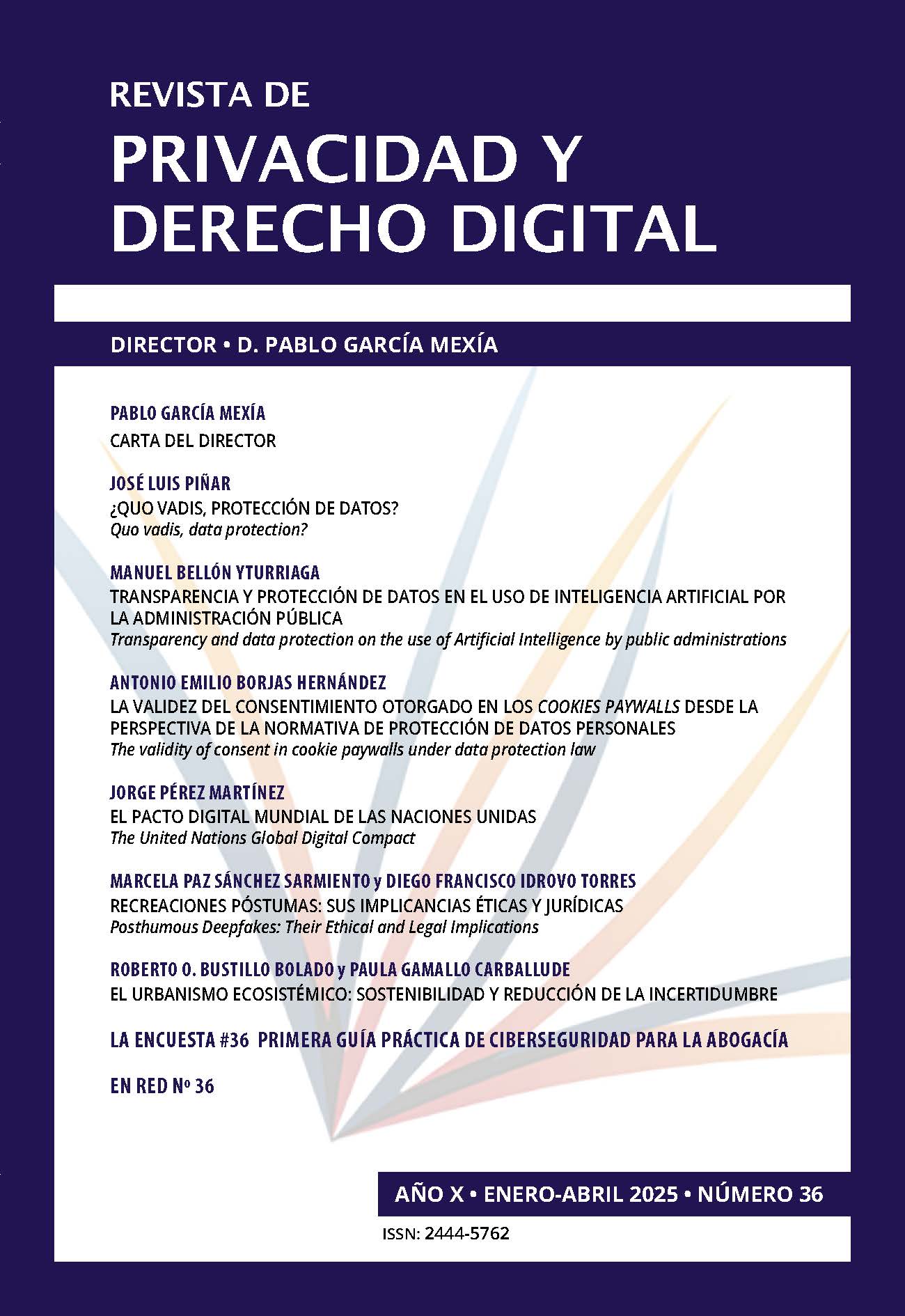
The United Nations Global Digital Compact
Abstract
This article analyzes the Global Digital Compact, recently approved within the United Nations. This compact is a set of principles, objectives, and actions agreed upon by states, intended to serve as a guide for governments, businesses, civil society, and other stakeholders in building a more equitable and sustainable digital future. Its importance lies in the fact that it is the first agreement signed by all sovereign governments in the world for international cooperation in the governance of the global digital ecosystem. To understand the compact, it is necessary to first analyze the evolution of the digital ecosystem, which was built between 2000 and 2017 in a context of geopolitical trust. This trust was broken in 2017 with the election of Donald Trump as President of the United States. Understanding this background will allow us to better describe the compact’s content and provide a critical assessment of it.
Downloads
References
BAES, K., CHEN, J., CHENG, Q., DUNEJA, R., PRAKASH IYER, S., KANAKA- MEDALA, V., . . . YANG, J. (2020). Think differently. Think archetype. Your digital economy model. Arthur D. Little. Huawei. Recuperado el 1 de marzo de 2025 de Think differently. Think archetype. Your digital economy model.
BRADFORD, A. Digital Empires: The Global Battle to Regulate Technology. Oxford University Press, 2023
DRAKE, WILLIAM J., CERF, VINTON G., KLEINWÄCHTER, WOLFGANG. Internet Fragmentation: An Overview. Future of the Internet Initiative White Paper. World Economic Forum, 2016.
FLORIDI, L. (2020). The Fight for Digital Sovereignty: What It Is, and Why It Matters, Especially for the EU. Philos. Technol, 33, 369-378. doi: https://doi.org/10.1007/s13347-020-00423-6
GJESVIK, L. Y SCHIA, N. N. (2023) Internet governance and the UN in a multiplex world order era?. Policy brief, n.º 5. Norwegian Institute of International Affairs. Recuperado el 1 de marzo de 2025 ht- tps://www.nupi.no/content/pdf_preview/26949/file/NUPI_Policy_ Brief_5_2023_Schia_Gjesvik.pdf
KNOWLES, J., HUNSAKER, T. The New Math of Multistakeholderism, MIT Sloan Management Review, 2022. Recuperado el 28 de febrero de 2025 de The New Math of Multistakeholderism
LYNCH, C. At UN, China seeks greater state control over internet. Devex (21 de mayo de 2024). Recuperado el 1 de marzo de 2025 de Ex- clusive: At UN, China seeks greater state control over internet | Devex
LÓPEZ GARRIDO, D. (2023). Autonomía estratégica abierta de Europa. Geopolítica y geoestrategia en el siglo XXI. Fundación Alternativas. Recuperado el 2 de marzo de 2025 de Autonomía estratégica abierta de Europa – Fundación Alternativas
PÉREZ MARTÍNEZ, J. HERNÁNDEZ-GIL GÓMEZ, J.F., ARTEAGA MARTÍN, F., MARTÍN NÚÑEZ, J.L. El futuro digital de Europa, Taurus, Madrid, 2020.
RAYMOND, M., SHERMAN, J. (2023) Authoritarian multilateralism in the global cyber regime complex: The double transformation of an inter- national diplomatic practice. Contemporary Security Policy, vol. 45, n.º 1, pp. 110–140.
RINGHOF, J. Multilateral internet: Unplugged and somewhat slightly dazed, en: Dworkin, A., Loss, R., Puglierin, J. (eds.) Shapes of multi- lateralism collection, ECFR y Stiftung Mercator, 2023. Recuperado el 2 de marzo de 2025 de Multilateral internet: Unplugged and somewhat slightly dazed | ECFR