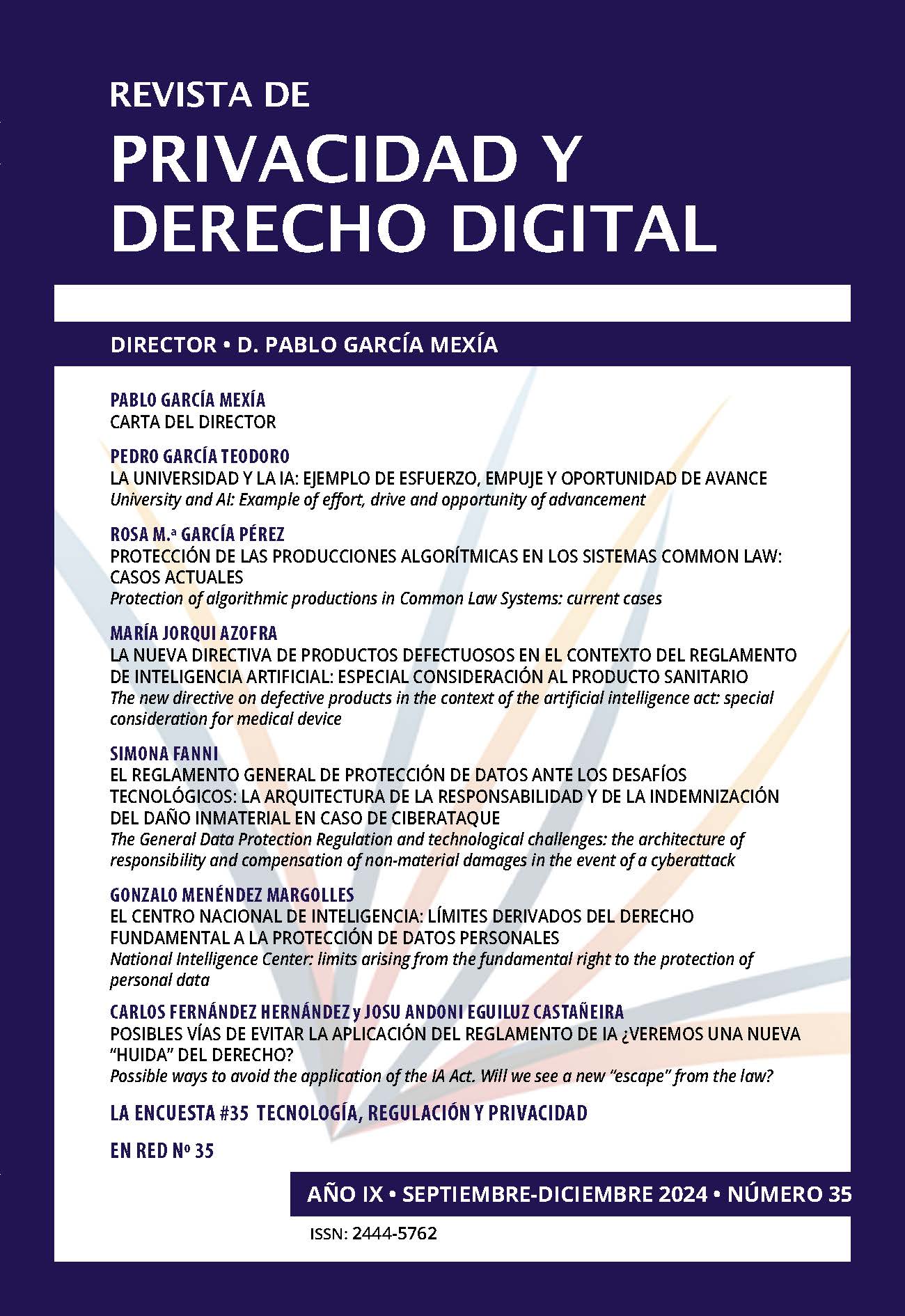
National Intelligence Center: limits arising from the fundamental right to the protection of personal data
Keywords:
Intelligence, personal data, National Intelligence Center, classified information.Supporting Agencies
Abstract
Intelligence activities are becoming increasingly important due to technological
development, reactivating the debate between privacy
and security. In Spain, the National Intelligence Center is the entity
responsible for providing the Government with the information required
to prevent and avoid attacks against National Security. For that, in
many cases, said Center needs to process personal data, causing an
impact in the fundamental right that protects them and demanding a
balancing test between the rights and interests at stake. However, National
Security has sometimes been used as a pretext for disproportionate
and abusive actions. In this regard, this article would examine
which are the regulations applicable to the processing of personal
data conducted by the National Intelligence Center, identifying their
potential specialties arising from their particular nature and sensitivity,
specifically the limits they impose to those processing activities in
order to protect citizens from abuses.
Downloads
References
AUTORIDAD DELEGADA PARA LA SEGURIDAD DE LA INFORMACIÓN
CLASIFICADA. (2012). Normas de la Autoridad Nacional para la Pro- tección de la Información Clasificada. Obtenido de https://www. buenjuicio.com/wp-content/uploads/2015/07/Normas_de_la_Au- toridad_Nacional_para_la_Proteccion_de_la_Informacion_Clasifi- cada.pdf
CATALINA BENAVENTE, M. A. (2023). Centro Nacional de Inteligencia, datos personales y proceso penal: un trinomio imperfecto. Estu- dios Penales y Criminológicos, nº 43, 1-52. Obtenido de https://doi. org/10.15304/epc.43.9427
CENTRO CRIPTOLÓGICO NACIONAL. (2015). Guía de Seguridad (CCN-
STIC-425). Ciclo de inteligencia y análisis de intrusiones. Obteni- do de https://www.ccn-cert.cni.es/en/series-ccn-stic/guias-de- acceso-publico-ccn-stic/1093-ccn-stic-425-ciclo-de-inteli- gencia-y-analisis-de-intrusiones/file.html
COMUNICACIÓN PODER JUDICIAL. (2023). “El Pleno del CGPJ aprueba el
informe al anteproyecto de Ley de Información Clasificada”. Obteni- do de Poder Judicial España: https://www.poderjudicial.es/cgpj/ es/Poder-Judicial/En-Portada/El-Pleno-del-CGPJ-aprueba-el-infor- me-al-anteproyecto-de-Ley-de-Informacion-Clasificada
CONSEJO DE TRANSPARENCIA Y BUEN GOBIERNO. (2022). Informe
sobre el Anteproyecto de Ley de Información Clasificada. Obtenido de https://www.consejodetransparencia.es/ct_Home/comunica- cion/actualidadynoticias/hemeroteca/2022/20221011.html
CONSEJO FISCAL. (2023). Informe del Consejo Fiscal al Anteproyecto de Ley de Información Clasificada. Obtenido de https://www.fiscal.es/ documents/20142/290789/Informe+CF+-+APLO+Información+- Clasificada+con+voto+particular_firmado.pdf/76878f30-1932- 38e0-060b-f754e803f63e?t=1675685875452
DE LA NUEZ SÁNCHEZ-CASCADO, E. (2022). El Anteproyecto de Ley de información clasificada: Un retroceso para la transparencia y rendición de cuentas. Hay Derecho. Obtenido de https://www. hayderecho.com/2022/10/24/el-anteproyecto-de-ley-de-infor-
EL CENTRO NACIONAL DE INTELIGENCIA: LÍMITES DERIVADOS DEL DERECHO FUNDAMENTAL A LA PROTECCIÓN DE DATOS PERSONALES
macion-clasificada-un-retroceso-para-la-transparencia-y-rendi- cion-de-cuentas/
ESTEBAN NAVARRO, M. A. (2004). Necesidad, funcionamiento y misión de un servicio de inteligencia para la seguridad y la defensa. Estu- dios sobre Inteligencia: Fundamentos para la Seguridad Internacio- nal (Cuaderno de Estrategia nº 127), 60-87.
JIMÉNEZ-PÉREZ, D. (2019). Legitimidad y control del Centro Nacional de Inteligencia. Grupo de Estudios en Seguridad Internacional (GESI), Universidad de Granada. Obtenido de https://www.ugr.es/~gesi/ congreso/comunicacion31-14.pdf
LÓPEZ AGUILAR, J. F. (2017). La protección de datos personales en la más reciente jurisprudencia del TJUE: los derechos de la CDFUE como parámetro de validez del derecho europeo, y su impacto en la relación transatlántica UE-EEUU. Teoría y Realidad Consti- tucional, nº 39, 557–581. Obtenido de https://doi.org/10.5944/ trc.39.2017.19165
MADDIO MEDINA, A., y SÁNCHEZ GUARIDO, A. (2020). El TJUE reabre el
debate entre privacidad o seguridad nacional. Diario La Ley. Obte- nido de https://diariolaley.laleynext.es/dll/2020/11/25/el-tjue-re- abre-el-debate-entre-privacidad-o-seguridad-nacional
MENÉNDEZ MARGOLLES, G. (2020). Qué es dato personal y qué no lo es. ¿Hacia una protección desmedida del dato?, en BERMÚDEZ SÁNCHEZ, J. y DE MARCOS FERNÁNDEZ, A. (Coords.) Transparen-
cia, lobbies y protección de datos, Cizur Menor, Aranzadi, 463-495.
MENÉNDEZ MARGOLLES, G. (2023). Tratamiento de datos personales en el marco de las actividades de inteligencia corporativa. Consi- deraciones jurídicas y base de legitimación aplicable. Revista de Privacidad y Derecho Digital, nº 30, 91-127.
RALLO LOMBARTE, A. (2017). El Tribunal de Justicia de la Unión Eu- ropea como juez garante de la privacidad en Internet. Teoría y Realidad Constitucional, nº 39, 583–610. Obtenido de https://doi. org/10.5944/trc.39.2017.19150
REVENGA SÁNCHEZ, M. (2019). El control del Centro Nacional de Inte- ligencia: una perspectiva comparada. Centro de Estudios Políticos
y Constitucionales. Obtenido de: https://www.cepc.gob.es/sites/ default/files/2021-12/3870901revenga-sanchez.html
TRANSPARENCY INTERNATIONAL ESPAÑA. (2022). Declaración conjunta sobre el Anteproyecto de Ley de Información Clasificada con motivo del día internacional del derecho a saber. Obtenido de ht- tps://transparencia.org.es/actualidad/declaracion-conjunta-sobre-el-anteproyecto-de-ley-de-informacion-clasificada-con-moti- vo-del-dia-internacional-del-derecho-a-saber/
WARNER, M. (2002). Wanted: A Definition of “Intelligence”. Studies in Intelligence, vol. 46, nº 3.