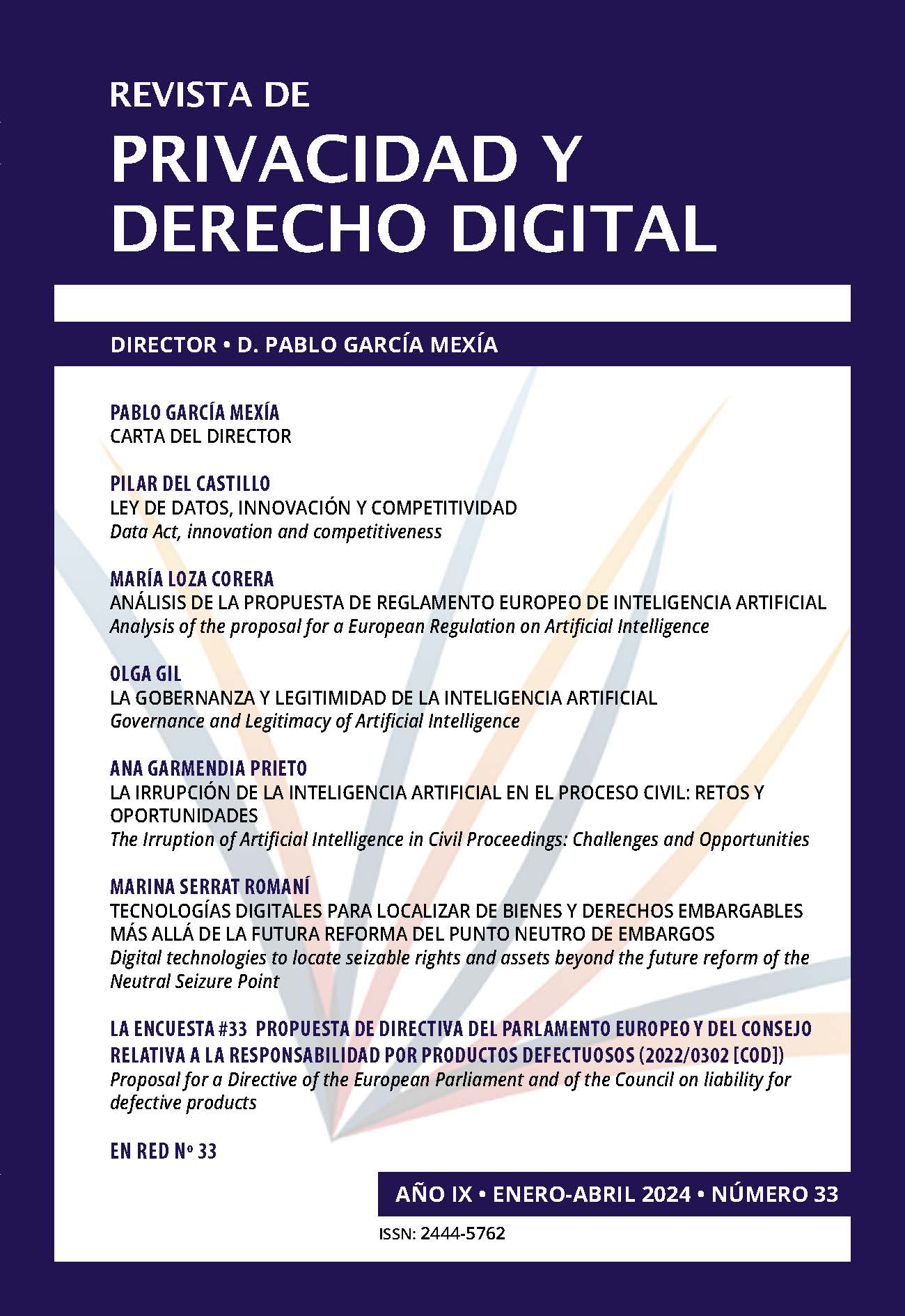
LA GOBERNANZA Y LEGITIMIDAD DE LA INTELIGENCIA ARTIFICIAL
Palabras clave:
Inteligencia artificial; gobernanza; filosofía; ética; teoría política; China.Agencias de apoyo
Resumen
Ante los desafíos para la humanidad de los desarrollos disruptivos
de la inteligencia artificial, este trabajo plantea discusiones desde
diferentes perspectivas, que permiten dialogar con científicos
de diferentes campos, gobiernos, empresas y otros actores
sociales sobre cuestiones relacionadas con la gobernabilidad y
la legitimidad. El objetivo principal y el resultado del artículo es
presentar un panel de control para el análisis de la gobernabilidad
y la legitimidad de la inteligencia artificial, al que se denomina Gil
Dashboard o Panel Gil. Este panel de control trata de resolver
disputas de teoría política partiendo de enfoques clásicos
para estudiar la gobernabilidad y la legitimidad. El panel de
control también permite comparaciones de la gobernabilidad
y la legitimidad de la IA en regímenes democráticos y no
democráticos, en diferentes niveles de gobierno – tanto en los
países Occidentales como en el Sur Global. Un resultado adicional
es la aplicación del Panel al caso de China como estudio de caso.
La aplicación del Panel de control permite 1) mostrar su valor
como herramienta metodológica y analítica y 2) arrojar una
nueva mirada interpretativa y sugerente a los datos existentes
en el caso chino.
Descargas
Citas
ABELLÁN, JOAQUÍN. El político y el científico: Weber. Madrid, Alianza Editorial. 2021.
BRANDT, LOREN, AND RAWSKI, THOMAS G. Policy, Regulation,
and Innovation in China’s Electricity and Telecom Industries, in Policy, Regulation and Innovation in China’s Electricity and Telecom Industries. Cambridge: Cambridge University Press, 13, pp. 1-51, 2019.
CHINOY, SAHIL. The Racist History Behind Facial Recogni- tion’, New York Times, 10 July, 2019, https://www.nytimes. com/2019/07/10/opinion/ facial-recognition-race.html. Últi- mo acceso noviembre 14th, 2023
CHOKSHI, NIRAJ. Facial Recognition’s Many Controversies, From Stadium Surveillance to Racist Software, New York Times, 15 May, 2019, https://www.nytimes.com/2019/05/15/business
/facial-recognition-software-controversy.html. Último acce- so noviembre 14th, 2023
CHUN, ANDY. Breaking the iron triangle: AI in China›s healthcare system. In NESTA. The AI Powered State. China›s Approach to Public innovation. pp. 19-27, 2020.
CONTERA, SONIA. (2022, Febrero 22) La nanotecnología llega a la vida [video]. https://youtu.be/vAYAnI6kqrY. Último acceso noviembre 14th, 2023.
CREEMERS, ROGIER. The ideology behind China´s AI strategy. NESTA. The AI Powered State. China´s approach to public innovation. 2020.
CREEMERS, ROGIER, TRIOLO, PAUL AND WEBSTER, GRAHAM.
‘Translation: Cybersecurity Law of the People’s Republic of China [Effective June 1, 2017]’, DigiChina for New America, updated 29 June 2018, https://www.newamerica.org/cybersecurity-ini tiative/digichina/blog/translation-cybersecu- rity-law-peoples-republic-china. Último acceso noviembre 14th, 2023.
DING, JEFFREY. Deciphering China’s AI Dream: The Context, Com- ponents, Capabilities, and Consequences of China’s Strategy to Lead the World in AI. Future of Humanity Institute, Oxford University. 2018
DING, JEFFREY. Promoting nationally, acting locally: China´s next generation AI approach. In NESTA. The AI Powered State. China´s Approach to public innovation, pp. 11-17, 2020
ECNS, Hangzhou Leads Nation in Attracting Overseas Returnees, ECNS Wire, 28 June 2018, http://www.ecns.cn/news/cns-wi- re/2018-06-28 /detail-ifyvrptq6363759.shtml. Último acceso noviembre 14th, 2023.
EICHLER, WILLIAM. Shockingly small number of councils em- brace automation. LocalGov. 10 May 2019. https://www. localgov.co.uk/Shockingly-small number-of-councils-em- brace-automation-stud y-reveals/47387. Último acceso no- viembre 14th, 2023
ELGAN, MIKE. ‘Uh-oh: Silicon Valley is Building a Chinese-Style Social Credit System’, Fast Company, 26 August 2019, ht- tps://www.fastcompany.com/90394048/uh-o h-silicon-va- lley-is-building-a-chinese-style-so cial-credit-system. Último acceso noviembre 14th, 2023.
GAL, DANIT. Perspectives and Approaches in AI Ethics: East Asia, in Oxford Handbook of Ethics of Artificial Intelligence, eds.
M. Dubber, F. Pasquale, and S. Das, Oxford: Oxford Univer- sity Press, 2020
GIANNI, LETIZIA. Democratic Accountability in Stressful Times: When Decisions Must Be Made Quickly. Penn State Journal of Law & International Affairs, vol. 11, no 1, p. 1, 2023
GIANNI, ROBERT, SANTTU LEHTINEN, AND MIKA NIEMINEN.
«Governance of responsible AI: from ethical guidelines to cooperative policies.» Frontiers in Computer Science 4, 2022
GIL, OLGA. AI Philosophy: Sources of Legitimacy to Analyze Arti- ficial Intelligence. The Sixth International Conference on Ad- vances in Computer-Human Interactions (ICDS- ACHI 2013) IARIA, Abril 24-28, 2023- Venecia, Italia. 2023, ISSN: 2308-
4138, ISBN: 978-1-61208-250-9, doi: 10.31219/osf.io/39njx
GIL, OLGA. Philosophy and Public Administration in China and Western Countries. Intel Prop Rights. Vol. 11 Iss. 1 No: 1000216, 2023, pp. 1-11.
HAN, EUGENIU. From Traffic Management to Smart Courts: Chi- na’s approach to smart cities, in The AI Powered State. In NESTA. China´s Approach to public innovation, pp. 35-41, 2020.
HAO, KAREN. China’s Xi Stacks Government With Science and Tech Experts Amid Rivalry With U.S. Wall Street Journal, Nov. 18, 2022, https://www.wsj.com/articles/chinas-xi-stac- ks government-with-science-and-tech-experts-amid-rival- ry-with-u-s 11668772682?utm_source=substack&utm_me- dium=email. Último acceso noviembre 14th, 2023.
HILLMAN, NOEL L. The Use of Artificial Intelligence in Gauging the Risk of Recidivism, The Judges, Journal 58, no. 1, pp. 36- 39, 2019.
HU, MINGHE. China Issues Rules to Stop Apps from Abusing User’s Personal Information in Latest Data Privacy Effort, South China Morning Post, 31 December, 2019, https:// www.scmp.com/tech/apps-social/article /3044051/china-is- sues-rules-stop-apps-abusin g-users-personal-information. Último acceso noviembre 14th, 2023.
HU, YUE, CHANGFENG CHEN, HONGNAN LIU AND KAI ZHOU.
Research on the Impact of AI and Big Data on the Trade Between China and other Countries along the Belt: Take the Application of Medical Economy as an Example, Changchun: SSER, 2019. https://webofproceedings.org/proceedings_se- ries/ESSP/SSER%202019/SSER30212.pdf Último acceso no- viembre 14th, 2023.
JUN, JONG S. Social Construction of Public Administration, The: Interpretive and Critical Perspectives. SUNY Press, 2012, pp. 83.
JUSTO-HANANI, RONIT. The politics of Artificial Intelligence regu- lation and governance reform in the European Union. Policy Sciences, vol. 55, no 1, pp. 137-159, 2022.
KIM, SUNG-YOUNG. Hybridized Industrial Ecosystems and the Makings of a New Developmental Infrastructure in East Asia’s Green Energy Sector, Review of International Political Economy 26, no. 1, pp. 158-182, 2019
LASKAI, LORAND AND WEBSTER, GRAHAM. Translation: Chinese Expert Group Offers Governance Principles for Responsible AI, DigiChina for New America, 17 June, 2019, https://www. newamerica.org/cybersecurity-ini tiative/digichina/blog/ translation-chinese-expe rt-group-offers-governance-prin- ciples-responsi ble-ai/. Último acceso noviembre 14th, 2023.
LEWIS, DEV. Separating Myth from Reality: How China’s Social Credit System uses public data for social governance. In NESTA. The AI Powered State. China´s Approach to public innovation. 2020.
LI, CHENYANG. ‘The Ideal of Harmony in Ancient Chinese and Greek Philosophy’, Dao 7, pp. 81-98, 2008.
LIU, YI-LING. The Future of the Classroom? China’s experience of AI in education, in The AI Powered State. China´s Approach to Public Innovation, pp. 27-34, 2020.
MATHESON, CRAIG. Weber and the Classification of Forms of Le- gitimacy. British Journal of Sociology, pp. 199-215, 1987.
NAUGHTON, BARRY. Chinese Industrial Policy and the Digital Silk Road: The Case of Alibaba in Malaysia, Asia Policy 27, no. 1, pp. 23-39, 2020.
ONGARO, EDOARDO. Philosophy and Public Administration. An Introduction. Northampton: Edward Elgar Publishing. 2018.
ROBERTS, HUW, JOSH COWLS, EMMIE HINE, JESSICA MORLEY, VINCENT WANG, MARIAROSARIA TADDEO, AND LUCIANO
FLORIDI. Governing artificial intelligence in China and the European Union: comparing aims and promoting ethical outcomes. The Information Society, pp. 1-19, 2022.
RYAN, MARIA. How Taiwan›s tiny chips are quietly shaping Con- versation. US geopolitics, The 22 August, 7 https://interes- tingengineering.com/culture/taiw an-tiny-chips-shape-us- geopolitics. Acceso noviembre 14th, 2023.
SHI, MINGLI, SAMM SACKS, QIHENG CHEN, AND GRAHAM WEBSTER. Translation: China’s Personal Information Security Specification, DigiChina for New America, 8 February 2019, https://www.newamerica.org/cybersecurity-ini tiative/digi- china/blog/translation-chinas-perso nal-information-securi- ty-specification/ Acceso noviembre 14th, 2023.
STANLEY, ISAAC, ALEX GLENNIE, AND MADELEINE GABRIEL. How
inclusive is innovation policy, Insights from an international comparison, London: Nesta, 2018.
State Council, New Generation Artificial Intelligence Develop- ment Plan, 2017. https://www.newamerica.org/cybersecu- rity-initiative/blog/chinas-plan-lead-ai-purpose-prosp ects- and-problems/ (Full English translation by a group of ex- perienced Chinese linguists with deep backgrounds on the subject matter, see this document from the New America foundation). Último acceso noviembre 14th, 2023.
State Council, Planning Outline for the Construction of a Social Credit System (2014-2020), China Copyright and Media, 14
June 2014, updated 25 April, 2015. https://chinacopyrigh- tandmedia.wordpress.com/2014/06/14/planning-outline- for-the-construction-of-a-social-credit-system-2014-2020/ Último acceso noviembre 14th, 2023-US Department of Commerce. Commerce Implements New Ex- port Controls on Advanced Computing and Semiconduc- tor Manufacturing Items to the People’s Republic of China (PRC). October 7, 2022.
VON CARNAP, KAI, SHI-KUPFER, KRISTIN. Values as a Quality Seal: Germany Should be More Active in Shaping Cooperation with China, MERICS blog: European Voices on China, 4 Sep- tember 2019, Mercator Institute for China Studies (MERICS), https://www.merics.org/en/blog/values-quality-seal-ger- many-should-be-more-active-shaping-Cooperation-china. Último acceso noviembre 14th, 2023
WHITE, GEOFF. Use of Facial Recognition Tech “Dangerously Irresponsible, BBC News, 13 May, 2019, https://www.bbc. com/news/technology-48222017. Último acceso noviembre 14th, 2023.
World Bank Group. Harnessing artificial intelligence for develo- pment the post-covid-19 era. A Review of National AI Strate- gies and Policies. May, 2021.
Xinhua, (CPC Congress) Full text of resolution on Party Consti- tution amendment. Oct., 22th., 2022. https://english.news. cn/20221022/fea670f419d7426ab564a795d5737b52/c.html Acceso noviembre 14th, 2023