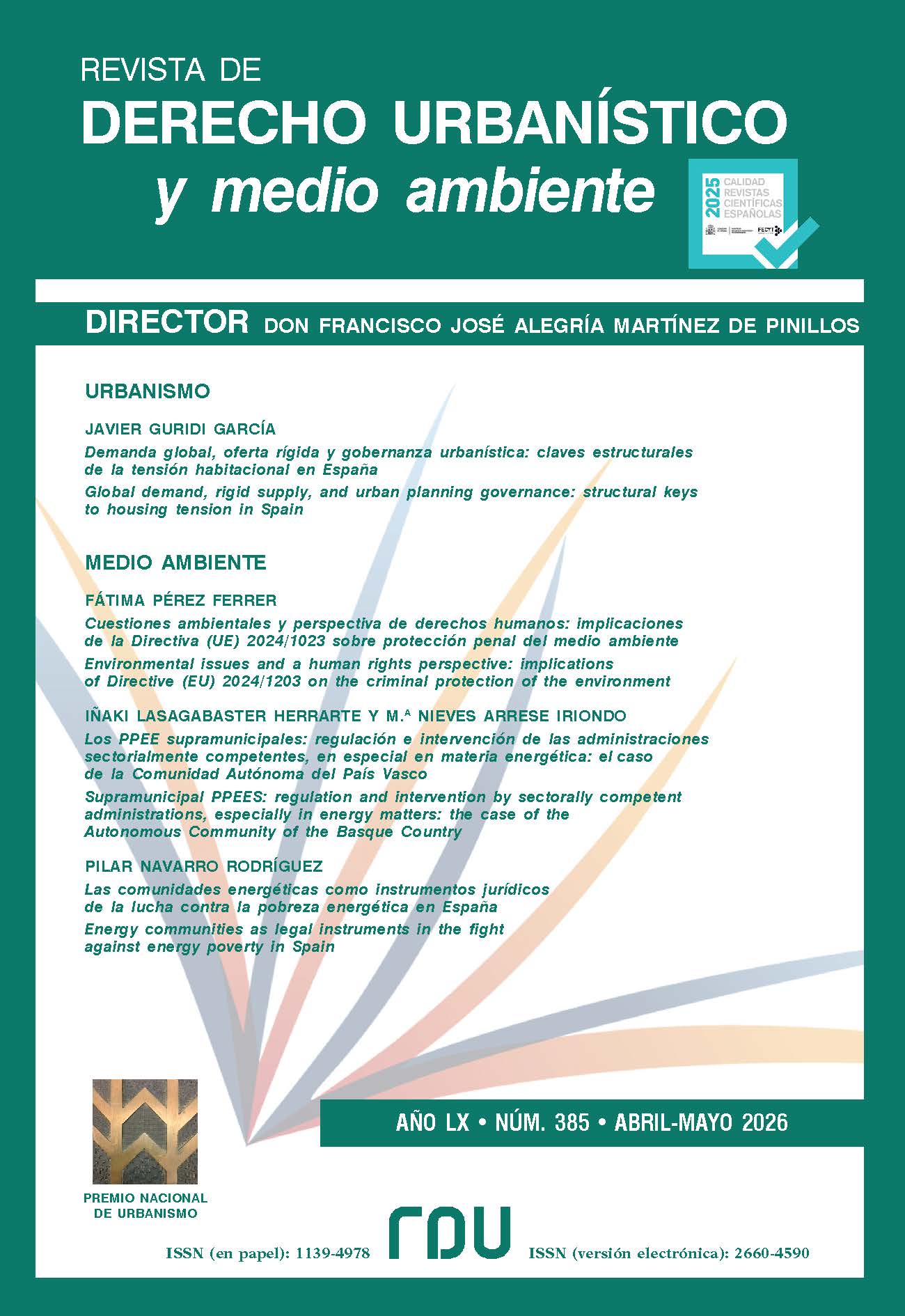
Global demand, rigid supply, and urban planning governance
structural keys to housing tension in Spain
Keywords:
Housing, housing demand, urban planning, housing solutionsAbstract
The Spanish housing market is undergoing a structural tension that cannot be understood as a cyclical episode nor as the result of speculative behaviour. Evidence points to a deeper phenomenon: a growing, diversified and increasingly globalised residential demand converging with a rigid supply restricted by scarce urban land, lengthy planning procedures and the institutional complexity derived from the sequential intervention of multiple administrative bodies responsible for protecting essential public goods.
Since 2016, household formation has consistently outpaced new housing production, driven by sociodemographic transformations, internal mobility, immigration, and new residential patterns linked to the digital economy and the arrival of international professionals. At the same time, Spanish cities have become integrated into a European and global residential market characterised by significant income differentials, transferring to local markets a purchasing power well above that of domestic households.
Additional pressures stem from urban tourism, particularly low‑cost tourism and the intensification of short‑term rentals in central districts, reshaping neighbourhood morphologies and reducing stable residential presence. On the supply side, the combination of finite urban land, underused obsolete fabric and administrative procedures lasting between 10 and 30 years generates structural inelasticity. The lack of coordination across local, regional and national administrations exacerbates delays and limits the system’s capacity to deliver housing at the pace required.
The Accessibility Ratio (Rac) is used as a complementary tool to illustrate the growing mismatch between household incomes and market prices. Recent policy measures, centred mainly on demand regulation, fail to address the structural origins of scarcity and may inadvertently reinforce it.
The conclusion is unequivocal: Spain’s housing tension is not another market cycle but the expression of a persistent mismatch between dynamic, globalised demand and a rigid, slow and constrained supply. Overcoming this imbalance requires deep planning reforms, stronger inter‑administrative coordination, large‑scale urban regeneration and a substantial expansion of affordable housing. Recent European recommendations to reduce planning timeframes reinforce the urgency of modernising the system to align supply rhythms with the speed of contemporary social demand.
Downloads
References
Banco de España (2023). Informe sobre la vivienda en España.
Eurostat (2024). Income and Living Conditions.
OECD (2023). Housing and Urban Policy Review.
UN-Habitat (2022). World Cities Report.
Fuente de datos:
Instituto Nacional de Estadística INE
IDEALISTA. Idealista.com. Evolución del precio de la vivienda en venta en España — idealista
MINISTERIO DE TRANSPORTES Y MOVILIDAD SOSTENIBLE Estimación del parque de viviendas | Ministerio de Transportes y Movilidad Sostenible
EUROSTAT (2024). Income and Living Conditions