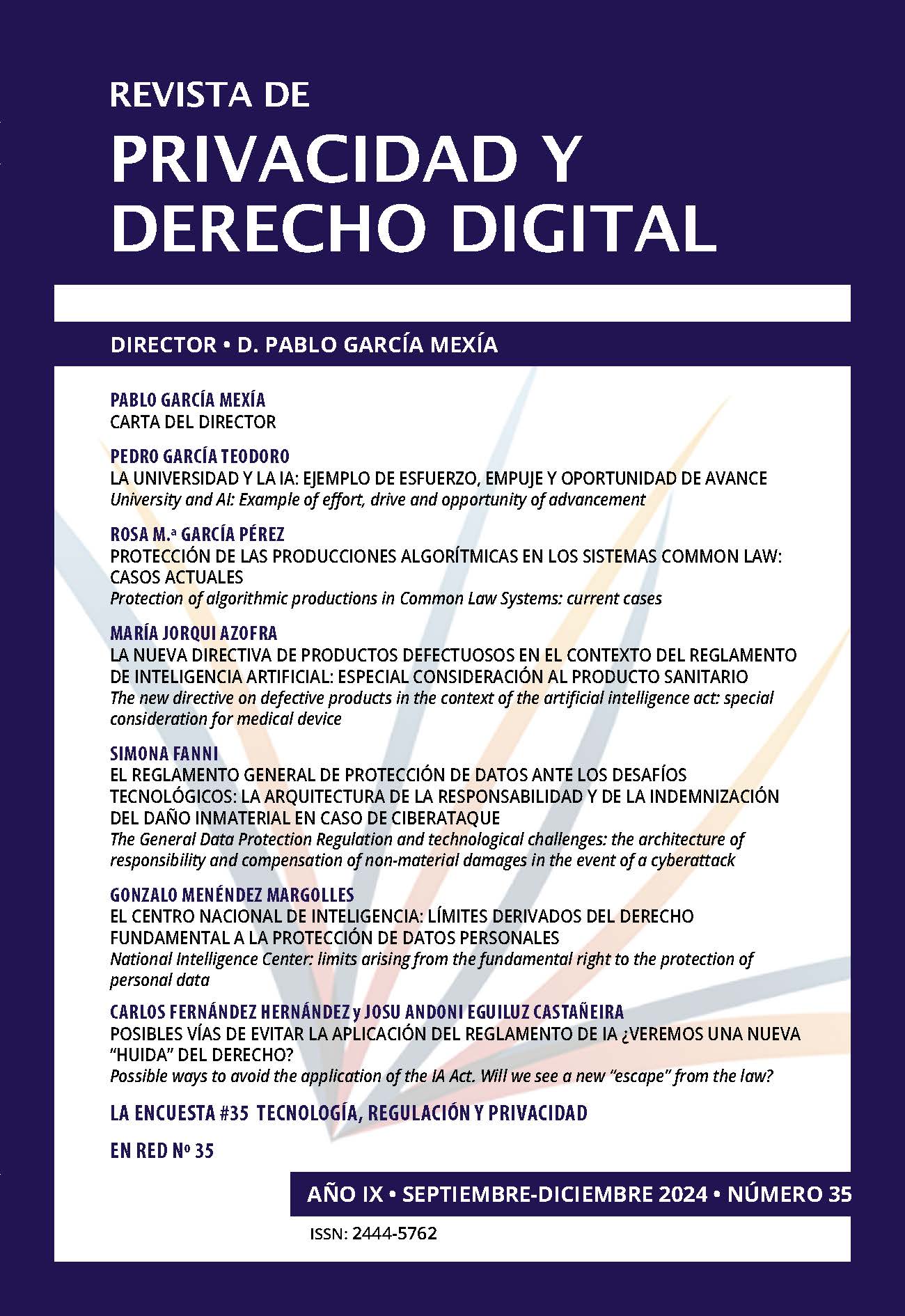
EL REGLAMENTO GENERAL DE PROTECCIÓN DE DATOS ANTE LOS DESAFÍOS TECNOLÓGICOS: LA ARQUITECTURA DE LA RESPONSABILIDAD Y DE LA INDEMNIZACIÓN DEL DAÑO INMATERIAL EN CASO DE CIBERATAQUE
Palabras clave:
Responsabilidad proactiva; daños inmateriales; ciberataque; principio de efectividad y principio de equivalencia; derechos y libertades fundamentales.Agencias de apoyo
Resumen
El asunto VB c. Natsionalna agentsia za prihodite ha ofrecido al Tribunal de Justicia de la Unión Europea (TJUE) la oportunidad de pronunciarse sobre cuestiones cruciales como la responsabilidad del responsable del tratamiento y la indemnización de los daños y los prejuicios inmateriales en el evento de un ciberataque, en el marco del Reglamento General de Protección de Datos. El presente estudio analiza detenidamente la decisión del TJUE, y formula una serie de observaciones y propuestas críticas, sugiriendo también la posibilidad de enriquecer la visión desarrollada en la sentencia a través de un enfoque basado en los derechos y las libertades fundamentales, en virtud del diálogo judicial entre el TJUE y el Tribunal Europeo de Derechos Humanos.
Descargas
Citas
BELISARIO, E., RICCIO, G.M., SCORZA, G., GDPR e Normativa Privacy –
Commentario, Wolters Kluwer, Alphen aan den Rijn, 2022;
DE BARRÓN ARNICHES, P., “Vulneraciones automatizadas del dere- cho a la protección de datos personales y mecanismos de tutela”, Revista de Derecho Civil, XI(1) (enero-marzo, 2024), Estudios, págs. 149-194;
DEMETZOU, K., “Data Protection Impact Assessment: A tool for ac- countability and the unclarified concept of ‘high risk’ in the Gene- ral Data Protection Regulation”, Computer Law & Security Review, núm. 35, 6, 2019, págs. 1-14;
DEMETZOU, K., “GDPR and the Concept of Risk: The Role of risk, the Scope of risk and the technology involved”, en Privacy and Identity Management. Fairness, Accountability, and Transparency in the Age of Big Data, 13th IFIP WG 9.2, 9.6/11.7, 11.6/SIG 9.2.2 International Summer School, Vienna, Austria, August 20-24, 2018, Revised Se- lected Papers, 2019, págs. 137-154;
DÍAZ LAFUENTE, J., “Los desafíos de la sociedad global digitalizada y la protección de datos personales. Análisis de la elaboración de perfiles en el Reglamento General de Protección de datos de la Unión Europea”, en El Reglamento General de Protección de Datos. Un enfoque nacional y comparado. Especial referencia a la LO 3/2018 de Protección de Datos y garantía de los derechos digitales, Tirant lo Blanch, Valencia, 2019, págDUIĆ, D., PETRAŠEVIĆ, T., “Data protection and cybersecurity: ca- se-law of two European Courts”, Eu and Comparative Law Issues and Challenges Series (ECLIC 7 - Special Issue), págs. 94-118;
ESTEPA MONTERO, M., “El principio de responsabilidad proactiva o rendición de cuentas como informador del régimen jurídico de la protección de datos de las personas físicas”, Anuario Jurídico y Económico Escurialense, núm. LV (2022), págs. 67-90;
FAHEY, E., “Does the EU’s Digital Sovereignty Promote Localisation in Its Model Digital Trade Clauses?”, European Papers, núm. 8(2), 2023, págs. 503-511;
GARCÍA SAN JOSÉ, D.I., European Normative Framework for Biomedical Research in Human Embryos, Editorial Aranzadi, Cizur Menor (Na- varra), 2013, págs. 99-100;
GELLERT, R., “Understanding the notion of risk in the General Data Protection Regulation”, Computer Law & Security Review, núm. 34, 2018, págs. 279-288;
GENTILE, G., “Effective judicial protection: enforcement, judicial fede- ralism and the politics of EU law”, European Law Open, núm. 2, 2023, págs. 128-143;
HALBERSTAM, D., “Understanding national remedies and the princi- ple of national procedural autonomy: a constitutional approach”, Cambridge Yearbook of European Legal Studies, núm. 23, 2021, págs. 128-158;
HELMINEN, P., “Analyzing the obscurities of the data protection im- pact assessment and “likely to result in a high risk” under Article 35 of the EU General Data Protection Regulation”, Bachelor’s the- sis, Programme HAJB08/17, Specialisation European Union and international law; Supervisor: Jenna Uusitalo, MA in international law, Ph.D Candidate at the University of Helsinki, Tallinn, 2021;
KUNER, C., BYGRAVE, L.A., DOCKSEY, C. (Coord.), The EU General Data
Protection Regulation: A Commentary. Update of Selected Articles, Oxford University Press, Oxford, 2021;
LENAERTS, K., “National remedies for private parties in the light of equi- valence and effectiveness”, Irish Jurist, núm. 46, 2011, págs. 13-37;
s. 287-310;
MARTÍN FABA, J.M., “Novedades en materia de indemnización y pro- tección de datos personales”, Revista CESCO, 49, 2024 , pág. 131- 147;
MAYOR GÓMEZ, R., “Contenido y novedades del Reglamento General de Protección de Datos de la UE” (Reglamento UE 2016/679, de 27 de abril de 2016)”, GABILEX, núm. 6, 2016, págs. 1-25;
MEGÍAS QUIRÓS, J.J., “RGPD y actividades personales en materia de protección de datos RGPD and personal activities in the field of data protection”, Persona y Derecho, núm. 80, 2019, págs. 147-178;
MULDERS, S., “Can GDPR damages be ‘effective’ without compen- sating personality harms?”, International Data Privacy Law, núm. 13(3), 2023, pág. 169-181;
NUSSELDER, S., “A Closer Look at the GDPR’s Security Requirements and Assessing the (In)Appropriateness of Technical and Organi- sational Measures (TOMs)”, European Data Protection Law Review, núm. 10(1), 2024, pág. 111-116,
ORDÓÑEZ SOLÍS, D., “Crónica de la Jurisprudencia del Tribunal de Jus- ticia de la Unión Europea. Segundo semestre de 2023. Case Law Review of the Court of Justice of the European Union”, Cuadernos Europeos de Deusto, núm. 70, 2024, págs. 171-216;
PRECHAL, S., “Horizontal direct effect of the Charter of Fundamental Rights of the EU”, Revista de Derecho Comunitario Europeo, núm. 66, 2020, págs. 408-426;
QUELLE, C., “The risk revolution in EU data protection law : We can’t have our cake and eat it, too”, en Data protection and privacy: The age of intelligent machines, Hart Publishing, Oxford, 2017;
RUBÍ PUIG, A., “Daños por infracciones del derecho a la protección de datos personales. El remedio indemnizatorio del artículo 82 RGPD”, Revista de Derecho Civil, núm. V(4), 2018, págs. 53-87;
SÁNCHEZ FRÍAS, A., Los conceptos autónomos en el Derecho de la Unión Europea, Tirant lo Blanch, Valencia, 2023;
SANTAMARÍA RAMOS, F.J., “El principio de responsabilidad proactiva: una oportunidad para un mejor cumplimiento de la normativa en
materia de protección de datos de carácter personal en el ámbito latinoamericano”, Derecho PUCP, núm. 85, 2020, págs. 139-174;
SCHMITZ, S., “Conceptualising the Legal Notion of ‘State of the Art’ in the Context of IT Security”, en Privacy and Identity Management. Between Data Protection and Security, Springer, Berlin, 2021, págs. 25-32;
SELZER, A., “The Appropriateness of Technical and Organisational Me- asures under Article 32 GDPR”, European Data Protection Law Re- view, núm. 1, 2021, págs. 120-128;
VILASAU I SOLANA, M., “La realización de perfiles y la salvaguardia de los derechos y libertades del afectado”, en Retos jurídicos de la inteligencia artificial, Editorial Aranzadi, Cizur Menor (Navarra), 2020, págs. 182-183;
VOIGT, P., VON DEM BUSSCHE, A., The EU General Data Protection Regu- lation (GDPR), Springer, Berlin, 2017;
WARREN, S., BRANDEIS, L., “The Right to Privacy”, Harvard Law Review, núm. 4(5), 1890, págs. 193-220;
WESTIN, ALAN, Privacy and Freedom, Atheneum, New York, 1970.